
The Automotive IoT Market Growth is experiencing dynamic growth, reflecting the increasing integration of smart technologies into vehicles. Automotive IoT refers to the connectivity between vehicles, infrastructure, and external devices, enabling real-time data exchange that enhances vehicle performance, safety, and user experience. The market was valued at approximately USD 130 billion in 2023 and is projected to grow at a compound annual growth rate (CAGR) of 20% through 2033, reaching over USD 558.97 billion by the end of the forecast period.
This surge is driven by advancements in connected vehicle technologies, the adoption of autonomous driving systems, and increasing consumer demand for enhanced driving experiences. The automotive IoT market is not only revolutionizing the way vehicles interact with each other and their environment but also transforming transportation ecosystems globally.
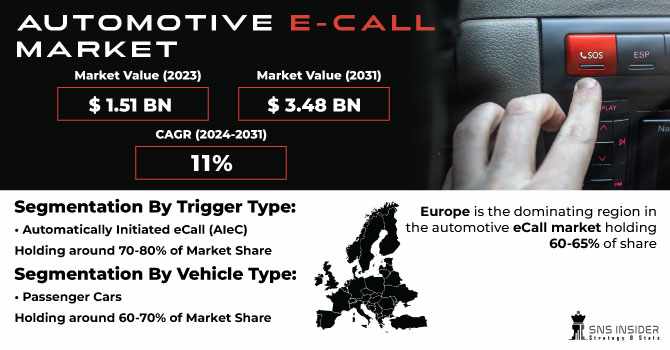
Get a Free Pdf Sample of Automotive e-Call Market Growth @ https://www.snsinsider.com/sample-request/1047
Major Players:
· Texas Instruments Inc. (U.S.)
· Intel Corporation (U.S.)
· NXP Semiconductors N.V. (Netherlands)
· Microsoft Corp. (U.S.)
· TOMTOM N.V. (Netherlands)
· IBM Corporation (U.S.)
· Apple Inc. (U.S.)
· Cisco Systems Inc. (U.S.)
· Thales SA (France)
· AT&T Inc. (U.S.)
· Vodafone Group (U.K.)
· Robert Bosch GmbH (Germany)
· General Motors (U.S.)
· Google Inc. (U.S.)
· Audi AG (Germany)
· Ford Motor Company (U.S.)
Segments Analysis:
The automotive IoT market is segmented by various key components that define its growth trajectory, ensuring a comprehensive understanding of the evolving landscape.
1. By Offering:
Hardware: This segment includes physical components such as sensors, chips, control units, and communication modules integrated into vehicles to enable connectivity. These components facilitate the gathering and transmission of data from vehicles to external systems, playing a critical role in IoT-enabled functions such as autonomous driving and advanced driver-assistance systems (ADAS).
Software: The software aspect involves platforms and applications that interpret the data collected by the hardware. These software solutions manage communication between vehicles and external systems, enabling real-time updates, predictive maintenance, and vehicle-to-everything (V2X) communication.
Services: Services include maintenance, integration, and support services that ensure the smooth functioning of automotive IoT systems. These services are vital for updating software, monitoring system health, and ensuring that IoT systems remain operational and efficient.
2. by Communication:
In-Vehicle Communication: This type of communication focuses on the data exchange between various systems within a vehicle, such as the infotainment system, engine control unit, and ADAS. In-vehicle communication enhances driver experience by integrating multiple systems and providing real-time feedback on vehicle performance.
Vehicle-to-Vehicle Communication (V2V): V2V communication allows vehicles to communicate directly with one another, exchanging data on speed, location, and traffic conditions. This communication enhances road safety by enabling vehicles to respond proactively to potential hazards, such as sudden stops or lane changes, significantly reducing the risk of collisions.
Vehicle-to-Infrastructure Communication (V2I): V2I communication links vehicles with infrastructure elements, such as traffic signals, toll booths, and road signs. This communication provides real-time updates on road conditions, traffic patterns, and navigation, optimizing driving routes and improving traffic flow efficiency.
3. by Connectivity:
Embedded Connectivity: Embedded connectivity refers to systems built directly into vehicles, offering continuous communication with external systems. These systems provide real-time updates on vehicle performance, enabling features such as remote diagnostics, over-the-air (OTA) updates, and autonomous driving.
Tethered Connectivity: Tethered connectivity involves linking a vehicle to external devices through physical connections, such as USB ports or Bluetooth, enabling the vehicle to access information from smartphones or other connected devices.
Integrated Connectivity: Integrated connectivity combines embedded and tethered systems to offer a comprehensive connectivity solution. This allows vehicles to access multiple communication sources, enhancing their ability to interact with external systems and providing a seamless driving experience.
4. by Application:
Infotainment Systems: Automotive IoT enables a richer infotainment experience, integrating smartphones, navigation systems, and entertainment platforms. Real-time data ensures that drivers and passengers can access the latest music, news, and road updates.
Autonomous Driving and ADAS: IoT plays a critical role in the development of autonomous vehicles and advanced driver-assistance systems by providing real-time data that enables safe decision-making. These systems rely on vehicle communication to navigate traffic, avoid collisions, and ensure passenger safety.
Fleet Management: IoT technology is revolutionizing fleet management by enabling real-time tracking, monitoring vehicle performance, and ensuring compliance with safety regulations. This communication optimizes fleet efficiency, reduces operational costs, and improves service delivery.
Predictive Maintenance: IoT allows vehicles to monitor their own health and notify drivers when maintenance is required, helping to prevent breakdowns and optimize vehicle performance. Real-time diagnostics data enables predictive maintenance that can be conducted before any severe issues arise.
Regional Overview:
The automotive IoT market is expanding across all major regions, with each region contributing to its unique growth patterns and trends.
North America: North America remains a leading region for automotive IoT adoption, driven by strong technological infrastructure and high consumer demand for connected vehicles. The U.S., in particular, has been at the forefront of integrating IoT technology into vehicle manufacturing, resulting in a significant focus on autonomous driving and smart transportation systems.
Europe: Europe is witnessing robust growth in automotive IoT adoption, supported by stringent vehicle safety regulations and a focus on reducing emissions through connected technologies. Countries such as Germany, the U.K., and France are leading the charge in adopting V2V and V2I communication systems, enhancing road safety and traffic management.
Asia-Pacific: Asia-Pacific is emerging as the fastest-growing market for automotive IoT, driven by the region's booming automotive industry and the increasing demand for connected vehicles. China, Japan, and South Korea are investing heavily in IoT technology, focusing on integrating smart city infrastructure and autonomous driving solutions.
Latin America and Middle East & Africa: These regions are gradually adopting automotive IoT technologies, with infrastructure developments and growing automotive markets. As vehicle production increases, these regions are expected to see a surge in demand for IoT solutions that enhance road safety and vehicle performance.
Recent Trends:
5G Technology: The rollout of 5G networks is accelerating the growth of automotive IoT by providing faster, more reliable connectivity. This advancement enables real-time data transfer, supporting applications such as autonomous driving and smart traffic management.
Edge Computing in IoT: Edge computing, which processes data closer to the source, is gaining traction in automotive IoT. This approach reduces latency, ensuring faster communication between vehicles and external systems, and enhances the efficiency of autonomous driving technologies.
OTA Updates: Over-the-air updates are becoming a standard feature in connected vehicles, allowing manufacturers to deploy software upgrades remotely. This capability enhances vehicle performance, security, and user experience without requiring a visit to the dealership.
Conclusion:
The automotive IoT market is poised for significant growth as the automotive industry continues to integrate advanced connectivity and communication technologies. As vehicles become more connected, safer, and more efficient, the demand for IoT-enabled systems will only increase. With the adoption of 5G technology, advancements in autonomous driving, and the ongoing development of smart cities, the automotive IoT market is set to transform the future of transportation. Companies and stakeholders in the automotive industry are encouraged to capitalize on these opportunities to stay ahead of the curve.
Read Full Details @ https://www.snsinsider.com/reports/automotive-iot-market-1047
Contact Us:
Akash Anand – Head of Business Development & Strategy

Phone: +1-415-230-0044 (US) | +91-7798602273 (IND)












Write a comment ...